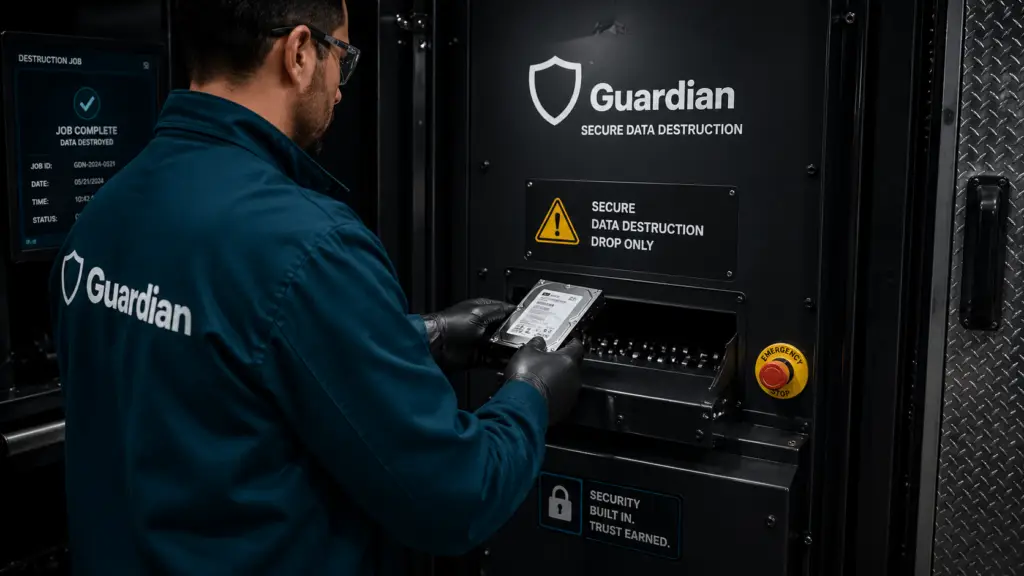
Onsite hard drive shredding is a physical destruction service performed at the customer facility. In a data center, a defensible service connects the approved destruction method to the asset inventory, media type, custody controls, verification, exception handling, and final documentation. The shredder matters, but the surrounding process determines whether the organization can account for every device and support the result after the project is complete.
This guide explains what data center teams should expect before, during, and after an onsite hard drive shredding event. It also identifies the questions that should be resolved before media is staged or equipment is removed from a rack.
This article provides operational guidance, not legal advice. Security, privacy, records, legal, and compliance teams should confirm the requirements that apply to each media population and project.
What Onsite Hard Drive Shredding Means
The current NIST SP 800-88 Revision 2 defines three sanitization methods: clear, purge, and destroy. Shredding is listed as a physical technique commonly associated with the destroy method. A destroy outcome must make recovery of the target data infeasible using state of the art laboratory techniques and leave the media unable to store data.
Physical damage alone does not establish that outcome. Drilling one hole, bending a device, or cutting only part of the media may leave recoverable areas. The selected technique and its output must be appropriate for the media construction, data density, security category, and organizational requirement.
Revision 2 adds a material warning for information storage media. As data density and material hardness increase, shredding and pulverization can become ineffective, and NIST advises avoiding those techniques above the lowest security categories. Organizations should therefore define the approved technique through their media sanitization program and consult the applicable organizational standard, IEEE guidance, or NSA specification when required. A provider should confirm that requirement during scoping rather than assume that one process fits every device.
When Physical Destruction Fits the Disposition Decision
Physical destruction may fit when storage media will not be reused, when the device is failed or obsolete, when a supported logical sanitization technique cannot be applied, or when an approved policy requires destruction. If the organization intends to reuse or remarket working media, an approved clear or purge technique may preserve more asset value.
Guardian’s guide to onsite data erasure versus shredding for audit compliance explains how reuse, media condition, evidence requirements, and disposition affect that choice. The decision should be approved before devices are removed from hosts or mixed into a destruction population.
Common trigger events include:
- Data center decommissioning or colocation exit
- Hardware refreshes and storage platform replacements
- Lease returns that require customer data to be removed before release
- Failed erasure devices that have moved into an approved destruction route
- Failed, obsolete, damaged, or unsupported storage media
- Backlog reduction events with a defined asset baseline and cutoff date
Why Onsite Changes Custody but Not Accountability
Destroying media before it leaves the facility can reduce the number of custody transfers that occur while data remains accessible. It can also allow the customer or an authorized witness to observe the process. Those advantages do not prove that the complete media population was processed.
A hard drive shredding service, like other hard drive destruction services, can only document the devices that enter its controlled workflow. If the project begins with an incomplete inventory, if drives remain inside servers, or if unidentified media is separated without an exception record, the final certificate cannot close those gaps. The asset baseline and reconciliation process must begin before destruction.
For projects connected to a wider infrastructure retirement, use a data center decommissioning plan that connects system release, equipment identification, media decisions, removal, sanitization, logistics, and project closeout.
What Must Be Defined Before the Service Date
1. Approved media population Define which devices are authorized for physical destruction. Separate hard disk drives, solid state media, tapes, optical media, embedded storage, and complete devices because they may require different techniques or equipment.
2. Method and output requirement State the approved sanitization method, destruction technique, output requirement, and source of the requirement. Do not leave particle size, device preparation, or media eligibility to an assumption made on the service date.
3. Inventory baseline Identify the expected asset count and the fields used for reconciliation. Serial number, asset tag, host device, rack or room, media type, and disposition route may be relevant depending on the project.
4. Site access and work area Confirm loading access, security screening, escort rules, permitted work hours, dock restrictions, floor loading, power needs, network limitations, and the staging area. The workflow should keep unprocessed media separated from processed remnants.
5. Device preparation Determine who removes media from host equipment, how embedded or unexpected storage will be handled, and whether complete devices are eligible for processing. Clarify any batteries, capacitors, caddies, carriers, or non-media components that must be removed.
6. Evidence and witness requirements Define whether serialized capture, photographs, video, customer witnessing, operator identification, timestamps, or additional approvals are required. The reporting fields should be agreed before processing starts.
7. Exception routes Create an approved path for unreadable labels, duplicate serials, unlisted devices, incompatible media, equipment jams, damaged drives, missing assets, and devices that cannot meet the selected destruction requirement.
How an Onsite Shredding Event Should Run
Controlled Intake
The team should establish a controlled intake point between the customer staging area and the destruction equipment. Only authorized media should enter the queue. Containers, carts, cages, pallets, or work zones should remain distinguishable by status so unprocessed devices are not confused with completed material.
Device Identification
The approved inventory fields should be captured before the label or enclosure is destroyed. If a serial number cannot be read, the operator should not invent or reuse an identifier. The item should move into the documented exception route and receive a project-specific reference if the approved procedure allows it.
Media Confirmation
Operators should confirm that the device matches the approved media class and equipment capability. An HDD, SSD, tape cartridge, optical disc, and embedded flash component do not present the same physical structure. Media type must be confirmed before selecting or accepting the technique.
Physical Destruction
Authorized media is fed into the approved equipment under the documented operating procedure. Throughput targets should not override custody, safe operation, inspection, or reconciliation. If an item does not process as expected, it should be isolated and recorded instead of being counted as complete.
Remnant Inspection
NIST Revision 2 states that verification for destructive methods involves inspecting the remnants and identifying the equipment used. The inspection should determine whether the process completed and whether the output meets the approved requirement. A successful machine cycle does not automatically mean the result is acceptable.
Exception Closure
Exceptions should remain visible until an authorized person accepts a new route or confirms completion. This is especially important for devices that fail an erasure attempt, media that does not match the original scope, and storage discovered inside equipment after the approved inventory was created.
Final Reconciliation
The processed population should be reconciled to the approved baseline. The closeout should identify completed assets, approved exceptions, missing items, duplicate records, and any media moved to another disposition route. Project completion should not be declared while unresolved devices remain outside the final status report.
What Verification and Validation Mean
NIST Revision 2 separates verification from validation. Verification determines the outcome of the sanitization technique. For physical destruction, that includes inspecting the remnants and identifying the equipment used. Validation considers the verification result, the media, the sensitivity of the target data, errors, anomalies, and the approved requirement. It then accepts or rejects the result.
This distinction matters during onsite hard drive shredding. A device may pass through the equipment but still fail validation if the output is larger than the organization’s accepted requirement, if the wrong media class was processed, or if the approved method was not appropriate for the data category. Rejected results require another approved technique or escalation.
What the Certificate Should Prove
A certificate of data destruction records the action taken. It does not independently prove that every media device owned by the organization entered the process. For data destruction compliance, its value depends on the inventory, custody, reconciliation, verification, and validation records that support it.
NIST Revision 2 recommends a certificate of sanitization for each sanitized information storage medium according to organizational policy. Its sample fields include manufacturer, model, serial number, property number when applicable, media type, source, sanitization method, technique, tool, verification method, validator information, date, location, and signature.
For a data center project, the closeout package may also need:
- The approved project scope and media population
- A device-level result file or consolidated asset report
- Exception records and final dispositions
- Custody transfers within the service workflow
- Witness or authorization records when required
- Final reconciliation against the customer baseline
- The downstream destination for destroyed material when included in scope
Retention periods and the system of record should be defined by the customer’s policy. A report that cannot be located during an audit has limited operational value, even if the original service was completed correctly.
What Happens to Destroyed Material
Physical destruction produces material that still requires controlled handling. The statement that data has been destroyed is separate from the environmental and downstream disposition of the remnants. The project scope should identify who controls the material after processing, how it is contained, where it is transported, and what downstream documentation is expected.
If the service includes packing, transportation, recycling, or another disposition activity, those steps should have their own custody and reporting requirements. The data destruction certificate should not be used as a substitute for downstream recycling or disposition records.
Questions to Ask a Hard Drive Shredding Service
| Evaluation Area | Question |
| Media and method | How does the provider confirm that the selected technique is appropriate for each media type and security requirement? |
| Equipment | What equipment will be used, and what approved output requirement will be verified? |
| Custody | How will unprocessed media, in-process media, remnants, and exceptions remain separated and controlled? |
| Inventory | Which identifiers will be captured, and how will the final results reconcile to the customer baseline? |
| Exceptions | What happens when a label is unreadable, a device is not in scope, or an item cannot be processed as planned? |
| Evidence | What verification, validation, witness, and certificate fields will be delivered? |
| Capacity | Can the provider support the expected media mix, volume, access window, and multi-site schedule? |
| Certification | Which independently audited operational certifications apply to the service and location? |
| Downstream handling | How will destroyed material be secured, transported, and documented after processing? |
Onsite Shredding Readiness Checklist
[ ] The customer has approved the media population and disposition decision
[ ] Media types are separated and matched to approved techniques
[ ] The destruction output requirement is documented
[ ] The expected asset count and identifiers are available
[ ] The staging area separates status populations
[ ] Site access, escort, power, dock, and work-hour requirements are confirmed
[ ] Device preparation responsibilities are assigned
[ ] Witness and reporting requirements are documented
[ ] Exception routes have named approvers
[ ] The final certificate and reconciliation fields are agreed
[ ] Downstream handling of remnants is included in scope
How Guardian Supports Onsite Data Destruction
Guardian supports enterprise data centers, ITAD providers, VARs, and MSPs with nationwide onsite data destruction services. A project can combine media identification, serialized reconciliation, onsite hard drive shredding, approved SSD destruction, erasure for eligible reusable media, equipment removal, packing, logistics, exception management, and final reporting according to the agreed scope.
Guardian maintains i-SIGMA NAID AAA Certification for secure data destruction operations. NAID AAA Certification includes independent audits of operational and security controls. It supports provider due diligence, but it does not replace the customer’s media sanitization policy, legal review, approved method, or acceptance of the final evidence.
The Guardian team scopes the media mix, quantities, locations, access conditions, schedule, required evidence, and disposition path before deployment. This allows the field workflow and reporting package to be built around the project requirements rather than applied as a generic destruction event.
Plan Your Onsite Destruction Event
Share your media types, quantities, locations, schedule, and evidence requirements with Guardian. Request a project review.
Frequently Asked Questions
Is onsite hard drive shredding automatically NIST compliant?
No. NIST SP 800-88 Revision 2 provides a risk-based media sanitization framework. It does not approve every shredding process for every device or security category. The organization must select an appropriate method and technique for the media, information sensitivity, intended disposition, and approved standard, then verify and validate the outcome.
What is the difference between shredding and pulverization?
NIST describes shredding as cutting or tearing media into small particles. Pulverization reduces media to fine powder or dust through crushing, grinding, or another mechanical process. The label alone does not determine suitability. Media construction, data density, output, security category, and the applicable organizational standard determine whether a technique is acceptable.
Should hard drives be removed from servers before the service?
That responsibility should be defined during scoping. Drives may need to be removed, identified, and reconciled before destruction. Complete devices can also contain embedded or unexpected storage components. A clear preparation process reduces the risk of missed media and incorrect asset records.
Can the customer witness onsite destruction?
Yes, when witnessing is included in the site plan and safety controls. The scope should define who may witness, where they may stand, whether video or photographs are permitted, and how witness records will connect to the project documentation.
What should be included in a certificate of data destruction?
The certificate should identify the media and record the approved method, technique, equipment or tool, verification, validation, date, location, and responsible personnel according to customer policy. Device-level identifiers and final reconciliation records are especially important when the certificate must support an audit or investigation.
Does onsite destruction eliminate chain of custody risk?
No. It can reduce custody transfers before destruction, but risk remains if inventory, staging, status separation, exceptions, and reconciliation are weak. The organization still needs to account for every in-scope device from release through final disposition.
Can onsite shredding be part of a data center decommission?
Yes. The destruction event can be coordinated with asset verification, equipment removal, packing, logistics, recycling, or another approved disposition route. The project plan should keep destruction decisions, asset records, custody, and closeout evidence connected across the complete decommissioning scope.