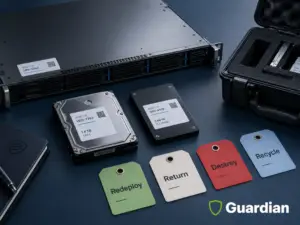
Data center migration can describe several different projects. It may refer to moving applications to the cloud, transferring workloads between environments, consolidating infrastructure, or physically relocating servers and network equipment.
This guide focuses on the physical side of migration: moving servers, storage systems, network devices, racks, and related hardware from one room or facility to another. That may include a move from an on premises environment to a colocation facility, a relocation between colocation sites, or a consolidation into a smaller physical footprint.
The distinction matters because physical migration requires a different operating model. Application teams may own backups, shutdowns, system validation, and restarts. The physical migration provider may own equipment verification, cable mapping, removal, packing, transportation, installation in the destination racks, and final reconciliation. Every responsibility should be explicit before the maintenance window begins.
Direct answer: Choose a physical data center migration provider that can define the complete scope from the source rack to the destination handoff. The provider should validate equipment and cable records, coordinate field work with the approved maintenance window, protect hardware and data throughout the move, document every transfer, install equipment according to approved plans, and manage exceptions through a clear escalation process.
Why Physical Data Center Migration Requires Integrated Execution
A physical migration crosses several operational boundaries. Work begins inside an active facility, continues through packing and transportation, and ends inside another controlled environment. The project may involve infrastructure owners, application teams, security personnel, facility operators, project managers, technicians, carriers, and the destination team.
A delay at any boundary can affect the entire sequence. An incorrect cable map can delay installation. An undocumented asset can create a reconciliation issue. Missing rails can stop equipment from being installed. A loading dock restriction can change the transportation schedule. A provider should therefore manage the move as one coordinated project rather than as a collection of independent tasks.
Use the following seven questions to determine whether a provider can support that level of execution.
1. Does the Provider Define the Complete Physical Migration Scope?
The first question should establish exactly where the provider’s responsibility begins and ends. The phrase “data center migration services” can describe a complete rack-to-rack project or a much narrower transportation assignment.
A complete physical scope may include a preproject walk-through, equipment verification, labeling, rack elevation review, cable mapping, decabling, removal from racks, packing, loading, transportation, unloading, installation in the destination racks, recabling to an approved map, and final reconciliation. Some projects require only part of that sequence.
The proposal should identify which party owns each activity, which records will be supplied by the customer, and which deliverables will confirm completion. It should also separate physical responsibilities from logical responsibilities such as application backups, operating system shutdown, network configuration, and production validation.
Ask for: A responsibility matrix, acceptance criteria, named handoff points, and a clear list of customer supplied information.
2. Has the Assigned Team Worked Inside Similar Data Center Environments?
General moving experience does not demonstrate the ability to work inside a live data center. Restricted access, security procedures, narrow maintenance windows, sensitive equipment, staging limitations, and facility rules all affect execution.
Ask for examples that resemble the planned move. Compare the type of equipment, number of racks, distance between facilities, complexity of the cable environment, destination requirements, and permitted work window. A single server shipment does not provide the same evidence as a coordinated move involving production storage, network devices, and multiple racks.
Confirm who will perform the work, who will manage the project, and how the assigned team will be briefed on the statement of work. The provider should be able to explain how technicians and carriers receive site specific requirements before arriving at either facility.
Ask for: A relevant case study, the proposed operating model, and confirmation that the assigned team understands the access and security requirements at both sites.
3. How Will Equipment, Rack Positions, and Connections Be Validated Before the Move?
A migration plan is only as reliable as the information behind it. Existing asset records may contain missing serial numbers, incorrect rack positions, outdated hostnames, undocumented devices, or cable information that no longer reflects the physical environment.
Before equipment is disconnected, the project team should establish a source of truth. Depending on scope, this may include serial numbers, asset tags, hostnames, equipment type, rack and unit position, destination rack position, rails, power connections, network ports, and approved cable maps.
The process should explain how discrepancies will be handled. Some exceptions can be resolved before the move. Others may need documented approval during the maintenance window. Either way, unresolved differences should not remain hidden inside spreadsheets or appear for the first time when the destination team begins installation.
Ask for: The validation method, matching rules, exception categories, and the final format for source and destination records.
4. How Will Physical Execution Align With the Shutdown and Restart Window?
The physical migration provider may not control application shutdown or production restart, but its work must align precisely with those activities. The schedule should identify when each equipment group is released, when physical custody changes, when transportation begins, and when the destination team can start installation and validation.
A credible plan should account for equipment sequence, staffing, site access, security check in, staging space, elevators, loading docks, truck positioning, travel time, destination readiness, spare packing materials, rail availability, communication cadence, and decision authority.
The team should also define hold points. For example, equipment should not leave the source site if the destination room is unavailable, the approved rack positions have changed, or the receiving team cannot accept custody. These decisions should be planned before the schedule becomes compressed.
Ask for: A detailed move schedule, communication plan, escalation path, and clearly defined go or hold decisions.
5. How Will Equipment Be Protected, Transported, and Reconciled?
Packing and transportation should reflect equipment sensitivity, value, route, handling events, and intended use at the destination. Reusable servers, storage systems, switches, and other components may require antistatic protection, foam, secure palletization, privacy wrap, shock protection, custom crating, or dedicated transportation.
Chain of custody should begin when responsibility for an asset changes, not when the truck departs. The project may require serialized scans, asset transfer records, photographs, seal numbers, Bills of Lading, pickup and delivery signatures, timestamps, and exception notes.
Carrier review should also be part of transportation planning. The FMCSA SAFER Company Snapshot provides public identification, operating, inspection, crash, and safety rating information for registered motor carriers. This information should support a broader qualification process rather than serve as the only decision factor.
For a deeper evaluation of packing, tracking, carrier qualification, and shipping protection, see Guardian’s guide to choosing a data center logistics provider.
Ask for: The packing specification, transportation model, custody records, tracking method, receiving process, and asset level reconciliation plan.
6. What Does Completion Mean at the Destination?
Delivery to the destination loading dock is not the same as completing a physical migration. The statement of work should define whether the provider will unload, unpack, install rails, place equipment in approved rack positions, connect cables according to customer supplied maps, remove packing materials, and support final equipment reconciliation.
The handoff should identify the status of each asset. Equipment may be installed and ready for customer validation, held because of an approved exception, or directed to another destination. The receiving team should know what was completed, what remains open, and who owns the next action.
Operational and application testing responsibilities must also be explicit. A provider may complete the physical installation while the customer’s infrastructure, network, and application teams perform power up, configuration, connectivity checks, and production validation.
Ask for: Destination acceptance criteria, final rack and cable records, receiving signatures, an open issue list, and the exact point at which responsibility transfers back to the customer.
7. How Will Exceptions and Equipment That Will Not Be Migrated Be Managed?
Even a well planned project can uncover undocumented hardware, unreadable labels, missing rails, damaged components, access delays, cabling differences, or destination rack changes. The provider should have a defined method for recording the exception, notifying decision makers, protecting the equipment, and documenting the approved resolution.
The project should also address equipment that will not move to the new environment. Assets may be placed into storage, returned to a lessor, redeployed elsewhere, prepared for resale, securely erased, physically destroyed, or sent to an approved recycling path.
If media will be sanitized or destroyed, the method should follow the organization’s security policy and applicable guidance. NIST Special Publication 800 88 Revision 2 provides current federal guidance for media sanitization. This requirement applies to data handling and disposition. It should not be presented as a substitute for migration experience, packing controls, or transportation accountability.
Guardian’s complete guide to data center decommissioning explains how inventory, data sanitization, packing, transportation, and final reporting connect when infrastructure is being retired.
Ask for: An exception log, decision authority, notification expectations, temporary storage controls, and a documented disposition path for every asset that will not be installed at the destination.
Data Center Migration Provider Evaluation Checklist
Use this checklist to compare provider responses against the actual physical scope of the project.
| Evaluation area | Strong evidence | Watch for |
| Scope | Rack to destination handoff responsibilities and acceptance criteria | The proposal begins with packed assets at the dock |
| Experience | Comparable live data center or colocation projects | Only general freight or office moving examples |
| Validation | Approved inventory, rack positions, cable records, and exception rules | Unverified spreadsheets treated as final |
| Schedule | Sequenced plan aligned with the maintenance window and site constraints | Generic timeline without hold points |
| Protection | Equipment specific packing, qualified transport, custody records, and reconciliation | One packing method for every asset |
| Destination | Defined installation, recabling, handoff, and open issue process | Completion defined as delivery |
| Exceptions | Named decision authority and documented paths for non-moving assets | Issues handled informally during the move |
How Guardian Supports Physical Data Center Migrations
Guardian supports ITADs, VARs, MSPs, OEMs, and infrastructure teams with nationwide field execution for physical data center moves. Services can be provided independently or coordinated within a broader migration, consolidation, refresh, or decommissioning project.
- Preproject walk-through and scope validation when required
- Device audit, verification, labeling, and reconciliation
- Cable mapping, decabling, and removal from racks
- White glove packing and secure transportation
- Installation in destination racks and recabling to approved maps
- Centralized project coordination and exception management
- Onsite data erasure or destruction for assets that will not be migrated
In one Guardian data center lift and shift project, the scope included cable mapping, device verification, decabling, removal from racks, white glove packing, secure transport, installation in destination racks, and recabling to customer supplied cable maps. The physical move into a colocation facility was completed during an approved weekend window.
The objective is to keep scope, equipment, responsibility, and documentation visible from the first source rack through the final destination handoff.
Frequently Asked Questions
What are physical data center migration services?
They are services used to plan, document, remove, protect, transport, install, and reconcile physical IT infrastructure as it moves between rooms, buildings, or data center facilities.
What is the difference between data center migration and data center relocation?
Data center migration can include applications, data, virtual machines, cloud environments, and hardware. Data center relocation refers more specifically to moving physical equipment from one location to another.
How early should a physical data center migration be planned?
Planning should begin as soon as the destination, approximate scope, and target maintenance window are known. The required lead time depends on equipment volume, site access, distance, cable documentation, staffing, transportation, and destination readiness.
Which documents should be created for a physical migration?
Common records include the statement of work, responsibility matrix, asset inventory, rack elevations, cable maps, move schedule, custody documents, Bills of Lading, exception log, destination records, and final reconciliation.
Can a migration provider also handle equipment that will be retired?
Yes. When included in the scope, assets that will not be migrated can be routed for storage, redeployment, lease return, certified erasure, physical destruction, resale, or recycling.
Can a provider guarantee that a migration will have no downtime?
A provider can protect the physical timeline through planning, sequencing, communication, and exception management. Application availability also depends on backups, shutdown, configuration, network, power up, and validation activities that may remain with the customer’s technical teams.
Plan the Move Before the Maintenance Window Begins
A successful physical data center migration is built before the first device is disconnected. Scope, responsibilities, inventory, cable records, packing, transportation, destination requirements, acceptance criteria, and exception handling should be agreed while the team still has time to resolve ambiguity.
Guardian helps partners and infrastructure teams coordinate physical data center migrations through one nationwide execution model. Share the source and destination, equipment counts, rack information, access requirements, target dates, and expected destination scope to begin planning your project. Discuss your next physical data center migration with Guardian