
NIST SP 800-88 Revision 2: A Practical Guide to Media Sanitization
Understand the latest media sanitization guidelines, compare Clear, Purge and Destroy, and build an effective data sanitization program aligned with your organization’s security requirements.
What Is NIST SP 800-88 Revision 2?
NIST Special Publication 800-88 Revision 2, Guidelines for Media Sanitization, is a publication from the National Institute of Standards and Technology that provides guidance for protecting sensitive information when storage media is reused, transferred, retired or disposed of.
Published on September 26, 2025, Revision 2 supersedes the 2014 edition and introduces a broader approach to managing media sanitization across the enterprise.
For organizations managing sensitive data, media sanitization is an essential part of the IT asset lifecycle. It connects information security, asset disposition, equipment reuse, regulatory obligations and corporate risk management.
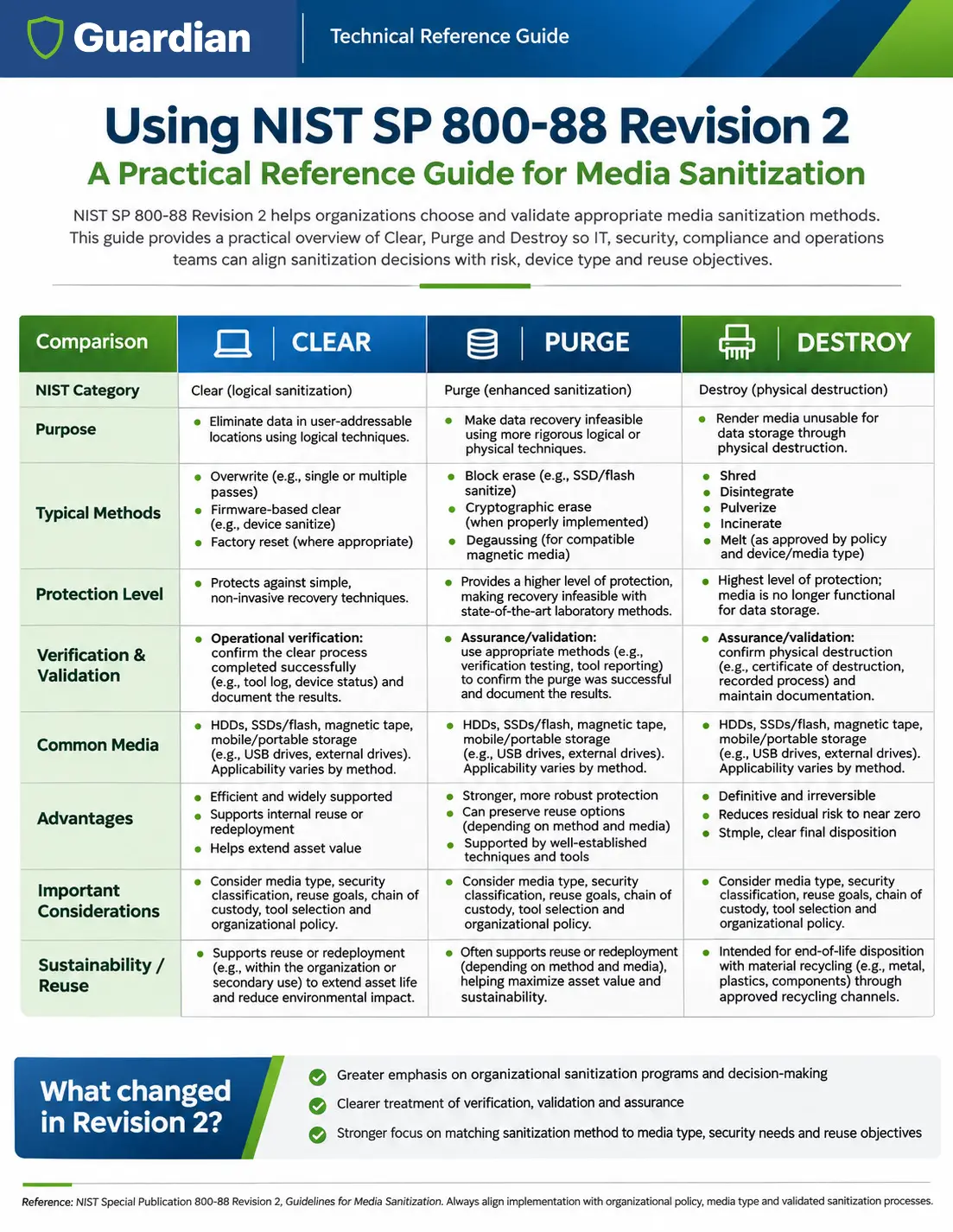
The updated guidelines retain three fundamental sanitization methods:
Clear. Purge. Destroy.
Selecting the appropriate method requires an understanding of data sensitivity, storage technology, equipment condition, intended disposition and organizational security policies.
The Purpose of Revision 2
- Define a lifecycle approach to media sanitization.
- Expand coverage to physical, logical and cloud environments.
- Strengthen assurance through verification and validation.
- Provide clearer guidance cryptographic erase and media reuse.
What Changed from NIST 800-88 Revision 1 to Revision 2?
Revision 2 expands the focus from individual sanitization procedures to the management of a comprehensive media sanitization program.
Organizations are encouraged to establish documented policies, define responsibilities, evaluate technology implementations and maintain evidence that sanitization activities achieve the required security outcomes.
The following comparison highlights the key changes.
| Topic | Revision 1 (2014) | Revision 2 (2025) |
|---|---|---|
| Focus | Sanitization techniques and methods. | A complete media sanitization program, including processes, roles and risk management. |
| Scope | Primarily physical media. | Physical, logical and cloud environments. |
| Cryptographic Erase | General guidance. | More detailed criteria and implementation considerations. |
| Assurance | Verification of the sanitization process. | Expanded assurance, including verification and validation. |
| Technology Guidance | Media-specific tables. | References to industry standards (e.g., IEEE 2883) and approved techniques. |
What This Means for Your Organization
IT asset disposition programs, procurement requirements, internal security policies and service provider agreements should be reviewed to reflect the updated guidance.
Organizations should also assess whether their existing sanitization techniques, documentation and verification procedures remain appropriate for their information security requirements.

Clear, Purge and Destroy: Understanding the Three Sanitization Methods
Media sanitization methods address different levels of recovery risk and media disposition requirements. The appropriate choice depends on the information being protected and the capabilities of the storage technology.
CLEAR
Logical Sanitization
Clear protects data against basic recovery attempts through logical operations applied to accessible storage areas.
Potential techniques include supported overwrite operations and appropriate device reset functions.
Clear may support equipment reuse when the organization’s security requirements permit it.
PURGE
Advanced Sanitization
Purge addresses more sophisticated data recovery threats, including advanced laboratory recovery capabilities.
Applicable techniques may include supported block erase commands and cryptographic erase and degaussing of compatible magnetic media.
Media reuse may remain possible, depending on the selected technique and device condition.
DESTROY
Physical Media Destruction
Physical Media Destruction
Destroy aims to prevent advanced recovery while permanently eliminating the media’s ability to store information.
The selected physical destruction technique must be appropriate for the storage technology, information sensitivity and applicable technical requirements.
Destroyed storage media cannot be returned to service.
Choosing the Right Method
The decision should balance information security, technical feasibility, regulatory obligations, equipment reuse objectives and documented organizational risk tolerance.
Media Sanitization by Storage Device Type
Different storage technologies require different sanitization considerations. Organizations should evaluate the characteristics of each device before selecting a method or technique.

Hard Disk Drives (HDDs)
Magnetic hard drives may support logical overwriting, device-specific sanitization commands, compatible degaussing or appropriate physical destruction.
The selection depends on drive functionality, media characteristics, information sensitivity and the intended destination of the equipment.

Solid State Drives (SSDs)
SSDs require special consideration because flash memory architecture, wear leveling and inaccessible storage areas can affect sanitization effectiveness.
Supported block erase operations, cryptographic erase and appropriate physical destruction techniques may be considered according to device capabilities and security requirements.

Magnetic Tape
Magnetic tape sanitization depends on recording technology, media characteristics and the required security outcome.
Compatible degaussing or suitable physical destruction techniques may be considered when retiring sensitive backup media.

Enterprise Servers and Storage Systems
Enterprise infrastructure may contain multiple storage devices, embedded flash memory, storage controllers and redundant data copies.
An effective sanitization program identifies all relevant storage components and addresses each according to its technical characteristics.

USB Drives, Memory Cards and Embedded Storage
Removable flash media and embedded storage require techniques that account for the underlying memory architecture and device-specific limitations.

Cloud and Virtualized Storage
Logical storage environments introduce additional considerations involving encryption, data replication, snapshots, backups and shared infrastructure.
Organizations should evaluate the controls and sanitization capabilities provided by their storage and cloud service providers.
Media Sanitization Verification, Validation and Documentation
A successful sanitization operation must be supported by evidence that the selected technique achieved its intended outcome.
Revision 2 distinguishes two complementary components of sanitization assurance.

Verification
Did the sanitization technique complete successfully?
Verification examines the operational outcome, including completion status, reported errors, equipment condition and other relevant evidence.
Validation
Does the outcome satisfy the organization’s security requirements?
Validation evaluates the available evidence in the context of information sensitivity, the selected technique and the organization’s acceptable risk.

Certificate of Sanitization
A Certificate of Sanitization provides a documented record of the sanitization activity.
Depending on the organization’s requirements, relevant records may include:
Manufacturer, model and serial number
Media type and asset identification
Sanitization method and technique
Equipment or software used
Verification and validation results
Date and location of sanitization
Responsible personnel
Intended media disposition
Documentation helps organizations demonstrate accountability and maintain evidence throughout the IT asset lifecycle.
Building a Media Sanitization Program Aligned with NIST Revision 2
An effective media sanitization program connects information security policies with operational procedures across the entire IT asset lifecycle.
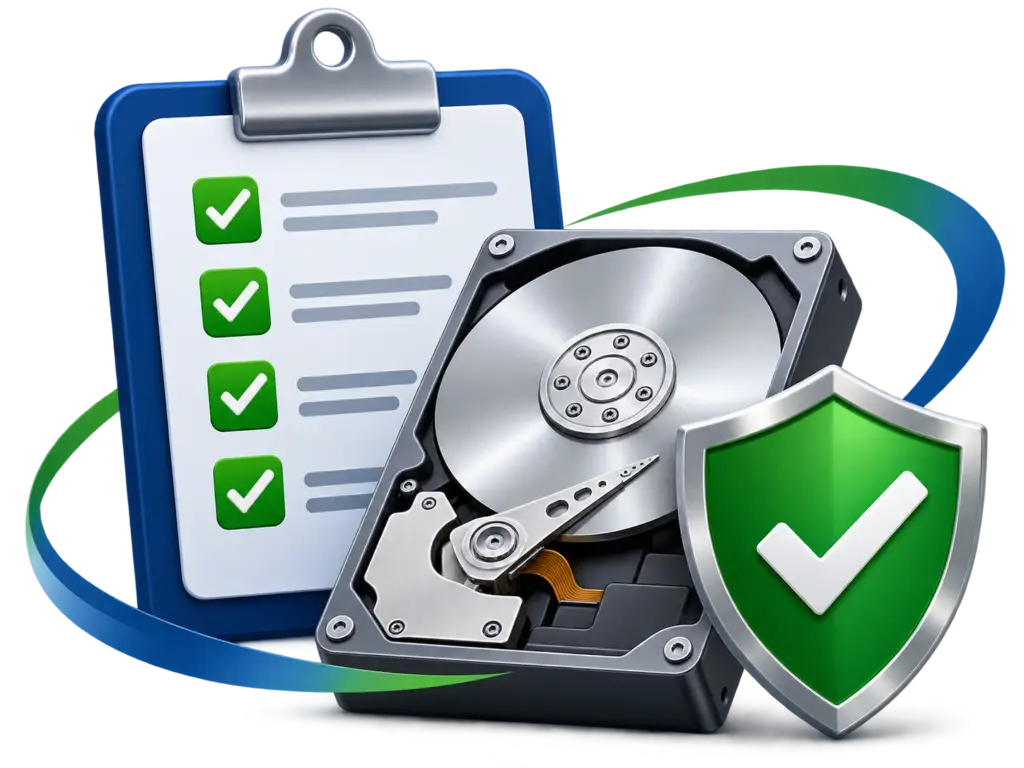
Use the following checklist to evaluate your organization’s readiness.
Add Your Heading Text Here
- Establish a documented media sanitization policy.
- Identify and classify information storage media.
- Define information sensitivity and confidentiality requirements.
- Select approved sanitization methods and techniques.
- Evaluate equipment capabilities and service provider qualifications.
- Assign operational responsibilities and accountability.
- Establish chain of custody procedures.
- Define verification and validation criteria.
- Maintain sanitization records and certificates.
- Establish procedures for unsuccessful sanitization attempts.
- Review policies as technologies and security requirements evolve.
- Align media disposition with security and sustainability objectives.
A documented program supports consistent decision-making across offices, data centers, remote locations and enterprise IT environments.
Frequently asked questions
About NIST SP 800-88
Is NIST SP 800-88 Revision 1 still current?
No. Revision 2 was published on September 26, 2025, and supersedes Revision 1. Organizations should review their existing sanitization policies and procedures against the updated guidelines.
What is the difference between Clear, Purge and Destroy?
Clear addresses basic data recovery risks. Purge addresses advanced recovery risks and may allow media reuse. Destroy addresses advanced recovery risks while permanently eliminating the media’s storage functionality.
Does NIST 800-88 require physical destruction of all hard drives?
No. The appropriate sanitization method depends on information sensitivity, storage technology, organizational policy and intended media disposition.
Does NIST require a specific number of overwrite passes?
Revision 2 does not require legacy multiple-pass overwrite patterns. Organizations should select an appropriate technique and establish evidence of its effectiveness.
Is degaussing considered Purge or Destroy?
Revision 2 identifies degaussing as a physical purge technique for compatible magnetic media. It is not a destroy technique and is unsuitable for flash memory.
Does NIST Revision 2 specify a universal shredding particle size?
No. Organizations should evaluate applicable technical standards, storage technology and information sensitivity when selecting physical destruction techniques. Particle size alone does not establish sanitization effectiveness.
What is cryptographic erase?
Cryptographic erase sanitizes the cryptographic keys required to access encrypted information. Its effectiveness depends on encryption implementation, key management and satisfaction of the applicable security requirements.
What is the difference between verification and validation?
Verification examines whether a sanitization technique completed as intended. Validation determines whether the resulting outcome meets the organization’s security requirements.
Is NIST 800-88 a law or certification?
Verification examines whether a sanitization technique completed as intended. Validation determines whether the resulting outcome meets the organization’s security requirements.
Can media sanitization support IT asset reuse?
Yes. When security requirements and device capabilities permit, appropriate Clear or Purge techniques can support equipment reuse, remarketing and lifecycle extension.
FREE DOWNLOAD
Get your NIST Revision 2 Reference Guide.
A practical reference for IT, security, compliance and ITAD professionals.
- Clear, purge and destroy comparison
- Media sanitization decision framework
- Implementation checklist
- Verification and validation guidance
Technical References and Additional Resources
This resource is based on publicly available media sanitization guidance and is intended for educational purposes.
Guardian’s Reference Guide is an independent educational resource and does not replace the official NIST publication. Organizations should evaluate their applicable security policies, contractual obligations, regulatory requirements and technical standards when selecting media sanitization methods.