Data destruction risk can look cost-free while every asset appears to follow the expected path. The cost becomes visible when an audit cannot connect a specific device to an approved method, a verified result, and a documented final disposition.
This problem becomes harder during a data center decommission, hardware refresh, cloud migration, lease return, or enterprise consolidation. Large volumes of mixed media move through different decisions at the same time. Some assets can be reused. Some must be returned intact. Some cannot complete an erasure process. Others have no remaining business value and should be physically destroyed.
The useful question is therefore not whether erasure or shredding is always more compliant. The useful question is which method fits the media, data sensitivity, intended disposition, organizational policy, and evidence requirement for each asset.
Direct answer: Onsite data erasure is generally appropriate when media must remain usable and an approved technique can be completed, verified, and validated. Onsite shredding is generally appropriate when media will not be reused and physical destruction is authorized, but the destruction technique must meet the required protection outcome for that media and data category. For either method, secure data destruction compliance depends on policy, inventory, custody, verification, validation, exception closure, and device level documentation. The method alone does not create compliance.
This article provides operational guidance, not legal advice. Organizations should confirm applicable legal, contractual, privacy, security, records, and industry requirements with their responsible teams.
Why the Method Alone Does Not Create Compliance
Erasure and shredding describe ways to sanitize or destroy media. An audit evaluates a broader control system. The organization must be able to explain why the method was approved, which assets were in scope, whether the process completed as intended, who reviewed the result, and what happened to every exception.
NIST Special Publication 800 88 Revision 2 provides a risk-based framework for media sanitization. It organizes sanitization into clear, purge, and destroy methods, then asks organizations to choose techniques according to media type, information sensitivity, intended disposition, environment, tools, time, cost, and other operational factors.
Regulations can also establish control outcomes without naming one universal technique. For example, the HIPAA Security Rule includes disposal, media reuse, and device and media accountability requirements for electronic protected health information. The FTC Disposal Rule uses a flexible standard that calls for reasonable measures based on the sensitivity of the information, available technology, and other circumstances.
A provider can supply tools, trained personnel, custody controls, and records. The organization remains responsible for connecting those services to its own requirements and approved policy.
Onsite Erasure and Shredding Compared
| Decision factor | Onsite data erasure | Onsite shredding |
| Asset outcome | Media remains usable when the process succeeds. | Media is physically damaged and generally cannot be reused. |
| Typical fit | Redeployment, resale, lease return, donation, or reuse under approved control. | Failed, obsolete, low value, end-of-life, or policy designated media. |
| Method dependency | The technique must be supported by the device and appropriate for the data sensitivity and disposition. | Physical technique and any downstream processing must meet the required outcome for the media and data category. |
| Primary evidence | Tool results are tied to the device, technique, verification, validation, and disposition. | Serialized reconciliation, custody, witnessed or recorded processing when required, destruction result, and final disposition. |
| Common exception | Inaccessible, damaged, unsupported, locked, or failed media cannot complete the approved process. | Incorrect media preparation, incomplete scope, unsuitable destruction technique, or unresolved downstream processing. |
| Business value | Can preserve reuse or resale value. | Removes reuse value but can simplify disposition for media that no longer has an approved use. |
When Onsite Data Erasure Fits
Erasure is valuable when the organization needs to remove data while preserving the media for an approved next use. Common examples include redeployment within the enterprise, resale through an authorized program, return to a lessor, or transfer to another controlled environment.
The word “erasure” is not specific enough for an audit decision. The approved technique may result in clear or purge under NIST terminology, depending on the media, device capabilities, implementation, and policy. A simple delete, quick format, or factory reset should not be assumed to meet the required sanitization outcome.
- The device and media type are identified accurately
- The selected technique is supported by the device and approved by policy
- The asset can communicate reliably with the erasure tool
- The result can be tied to a unique serial number or another controlled identifier
- Verification confirms that the technique was completed successfully
- Validation confirms that the outcome is acceptable for the data sensitivity and intended disposition
- Failed or unsupported devices enter a controlled exception path
Where Erasure Programs Commonly Fail
Large erasure programs often fail at the edges rather than in the software itself. A drive may not appear in the inventory. A serial number may be recorded differently in two systems. A device may be inaccessible because of damage, an interface problem, encryption state, firmware, or another condition. A tool may produce a result, but the result may not be associated with the correct asset or approved by a validator.
A defensible program treats every unsuccessful or incomplete result as an exception. The asset should remain controlled, its status should be visible, and the next approved method should be documented. Physical destruction is often the practical exception path when reuse is no longer required or erasure cannot be completed.
Audit evidence Device identifier, erasure method and technique, tool and version, start and completion record, verification result, validator decision, exception status, and final disposition
When Onsite Shredding Fits
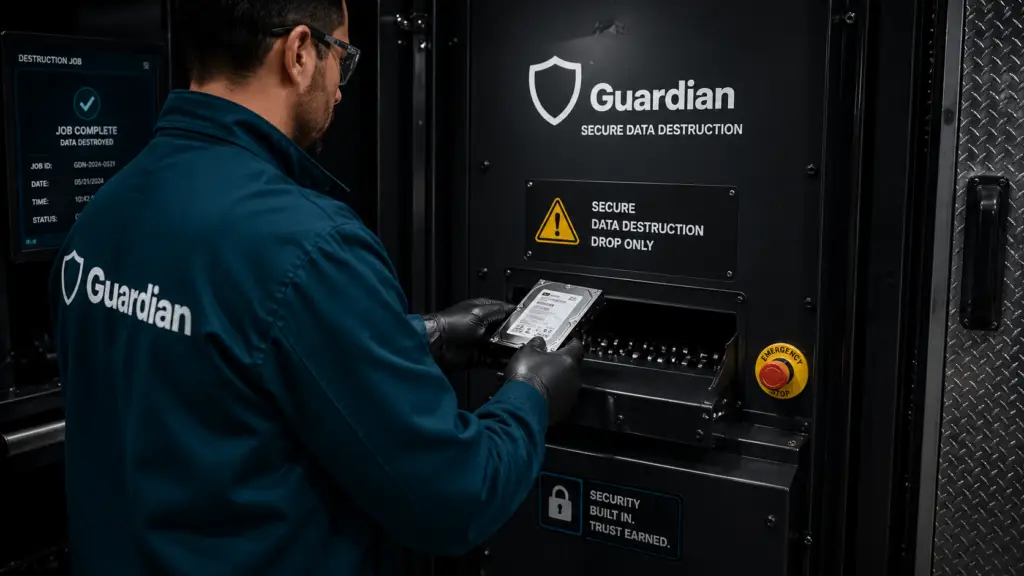
Onsite shredding can reduce custody and transit exposure by physically processing approved media before it leaves the facility. It is often selected for failed drives, obsolete media, assets with no approved reuse path, time-sensitive decommissioning, or policies that require a destroy outcome.
Shredding should not be treated as one universal specification. Media construction and data density differ across hard disk drives, solid state drives, flash devices, tapes, optical media, mobile devices, and embedded storage. The organization should define what media is included, how it must be prepared, what physical result is required, and whether additional downstream processing is part of the approved outcome.
NIST SP 800 88 Revision 2 cautions that shredding or pulverizing alone should be avoided for media containing data categorized above the lowest security level. For higher sensitivity media, an organization may need additional or alternative destruction techniques based on its policy and applicable guidance. The NIST Revision 2 FAQ reinforces the need to select a technique that matches the media and required protection outcome.
This limitation does not make onsite shredding irrelevant. It means the method must be specified and evidenced rather than assumed. A destruction record should show which media entered the process, which technique was used, whether the expected result was observed, who validated the result, and where the processed material went next.
Audit evidence Approved destruction specification, serialized intake, custody record, process date and location, operator and validator, observed result, exception record, and downstream disposition
What NIST Revision 2 Changes for Audit Evidence
NIST published Revision 2 of SP 800 88 in September 2025. It supersedes Revision 1 and places more emphasis on a program level approach, media specific technique selection, verification, validation, and documentation. Four implications matter when comparing erasure and shredding.
1. Clear purge and destroy are outcomes: An erasure technique may support clear or purge. A physical process may support destruction. The selected technique must be appropriate for the media and the required level of protection.
2. Pass counts are not the decision model: The framework does not make a universal multi-pass overwrite count the center of compliance. Teams should use approved techniques for the media and record the outcome that was actually achieved.
3. Verification and validation are separate: Verification checks whether the sanitization technique was completed successfully. Validation uses the verification result, information sensitivity, and other factors to decide whether the media is acceptably sanitized for its intended disposition.
4. Documentation must connect the asset and result: NIST identifies certificate fields such as manufacturer, model, serial or property number, media type and source, sanitization method and technique, tool and version, verification method, personnel, date, location, and signature.
What Auditors Need to See
An auditor should be able to follow the control from policy decision to device outcome. The strongest records answer eight questions without relying on memory or disconnected spreadsheets.
| Evidence area | Question the record should answer |
| Policy and authority | Who approved the sanitization rules and method selection criteria? |
| Scope baseline | Which assets and media were expected in the project? |
| Identity | How does each physical device map to the source inventory and result record? |
| Custody | Who controlled the device at each required transfer and location? |
| Method and technique | What was performed, and why was it appropriate for the media and disposition? |
| Verification | What confirms that the selected technique completed successfully? |
| Validation | Who accepted the result and on what basis? |
| Exception and disposition | What happened to failed, missing, extra, or otherwise unresolved media? |
Common Data Destruction Audit Gaps
1. A certificate without asset-level detail: A project certificate may confirm that a service occurred while leaving the auditor unable to prove the outcome for a specific drive or device.
2. An inventory that was never reconciled: Processing records can appear complete even when missing, duplicate, extra, or unreadable assets were not resolved against the approved baseline.
3. Failed erasure results without a closed exception: A failure log is useful only when the asset remains controlled and the final approved method and disposition are recorded.
4. A method that does not fit the media: A technique that works for one storage technology should not be assumed to produce the same result for every drive, flash device, tape, or embedded storage component.
5. Custody that starts too late: A record that begins at truck departure may omit removal, internal staging, media extraction, preparation, and other points where responsibility or location changed.
6. Tool logs that cannot be tied to a device: An erasure success count does not establish which specific assets succeeded unless identifiers remain consistent from intake through final disposition.
7. No named validator: Verification data may exist, but the program still needs an authorized decision that the result satisfies policy for the intended next use or disposition.
8. Downstream processing that is assumed: If the approved outcome depends on recycling, melting, incineration, or another downstream activity, the record should identify the responsible party, transfer, required evidence, and final status.
A Two-Path Workflow Is Usually Stronger
Enterprise projects rarely need one method for every asset. A two-path workflow can preserve value where reuse is approved and close risk where erasure is not possible or destruction is required.
| Decision point | Erasure path | Destruction path |
| Intended outcome | Reuse, return, resale, redeployment, or another approved transfer. | No reuse or policy requires destruction. |
| Eligibility check | Supported media, working interface, approved technique, reliable identification. | Approved media type and destruction specification. |
| Execution | Complete the approved clear or purge technique onsite. | Complete the approved physical destruction technique onsite. |
| Quality control | Verify completion and validate the result for the intended disposition. | Verify and validate the physical result and any required downstream step. |
| Exception | Route failed or unsupported media to controlled destruction. | Isolate any media that cannot be processed as specified. |
| Closeout | Reconcile device result and next owner or destination. | Reconcile device result, processed material, and final disposition. |
How to Decide During Enterprise Consolidation
Consolidations bring different asset outcomes into the same project. The method decision should occur before equipment is removed, mixed into a general logistics stream, or released to another party.
| Asset outcome | Likely starting point | Control question |
| Internal reuse | Approved clear or purge technique. | Will the media remain within authorized control, and is the result valid for the next use? |
| Lease return | Approved purge technique when supported. | What sanitization evidence does the lessor accept without physically altering the asset? |
| Resale or external reuse | Approved purge technique when supported. | Is the outcome appropriate before the asset leaves organizational control? |
| Failed or unsupported media | Approved destroy technique. | How will the device remain controlled from erasure failure through destruction? |
| Obsolete or low-value media | Compare approved reuse and destroy paths. | Does preserving the media create real value after processing, handling, and audit costs? |
| Highly sensitive media | Policy specific technique. | Does the selected technique meet internal and applicable external requirements for the media? |
Trigger Events That Should Start the Decision
Data destruction should be planned when the business event is approved, not after unwanted equipment has accumulated. Each trigger changes the method decision and the evidence that must be preserved.
| Trigger event | Decision to make early | Evidence to preserve |
| Data center decommission | Identify media for reuse, return, destruction, storage, or another disposition before removal. | Approved asset baseline, method by population, custody, results, and final reconciliation. |
| Hardware refresh | Separate reusable media from failed, obsolete, or policy designated destruction assets. | Old-to-new asset mapping, sanitization result, exception route, and disposition. |
| Equipment leaving a facility | Decide whether sanitization must occur before the custody boundary changes. | Release authorization, onsite result, custody transfer, and destination. |
| Lease return | Confirm the accepted sanitization method before the return window. | Lease requirements, device result, validator approval, and return receipt. |
| Cloud migration | Locate and disposition legacy media after workloads and retention needs are validated. | System owner release, media inventory, result, exceptions, and disposition. |
| Merger or facility consolidation | Create one decision framework across inherited inventories and policies. | Source system mapping, approved exceptions, custody, method result, and closeout. |
| Audit or compliance deadline | Reconcile the inventory before attempting to close evidence gaps. | Policy, scope, device records, validation decisions, and exception closure. |
| End of quarter or year | Set capacity and cutoff dates without weakening custody or evidence controls. | Scheduled population, completed results, backlog status, and open exceptions. |
Sample Audit Evidence Checklist
Use this checklist as a starting point. The final record set should reflect the organization’s policy, risk assessment, contracts, legal obligations, and audit requirements.
- Current media sanitization and disposition policy
- Named policy owner and approval date
- Approved method selection criteria by media, data sensitivity, and disposition
- Authorized project scope and source inventory
- Stable device identifiers and matching rules
- Documented custody start point, handlers, locations, and transfers
- Erasure tool, version, method, technique, and device level result
- Destruction method, technique, date, location, and observed result
- Verification record for each processed asset or approved population
- Named validator and validation decision
- Exception categories, custody status, corrective action, and closure evidence
- Final reconciliation of expected, processed, exception, and missing assets
- Approved downstream destination and related transfer evidence
- Retention period and system of record for certificates, logs, and supporting evidence
How Guardian Supports Secure Data Destruction
Guardian supports ITADs, VARs, MSPs, OEMs, and enterprise infrastructure teams with onsite data erasure and physical destruction services. The service can be delivered as a focused destruction event or coordinated within a data center decommission, hardware refresh, relocation, consolidation, or other asset disposition project.
- Preproject scoping by site, media type, quantity, schedule, access, and evidence requirement
- Serialized asset verification and reconciliation
- Onsite erasure for eligible media using an approved project workflow
- Controlled exception routing for media that cannot complete erasure
- Onsite physical destruction for approved media populations
- Chain of custody records and centralized project coordination
- Project reporting that connects asset identity, outcome, exception, and disposition
- Nationwide field execution for single site and multisite programs
Guardian’s data center decommissioning guide explains how disposition decisions connect to inventory, removal, sanitization, packing, transportation, resale, recycling, and closeout. Its relocation risk assessment shows why custody and exception controls must start before equipment moves.
Guardian maintains NAID AAA Certification for secure data destruction operations. Certification can support provider due diligence, but it does not replace the customer’s policy decision, regulatory analysis, scope approval, or review of the final evidence.
Frequently Asked Questions
Which Method Is Better for Compliance
Neither method is automatically better. Erasure generally fits media that must remain usable. Shredding generally fits media that will not be reused and is approved for physical destruction. The defensible choice depends on media type, data sensitivity, intended disposition, policy, technique, verification, validation, and evidence.
Does a Certificate Prove Every Drive Was Processed?
A certificate is one part of the evidence. Device level proof also requires a reliable source inventory, stable identifiers, processing results, reconciliation, exception closure, and a documented validation decision. A project level certificate without those supporting records may not resolve an asset specific audit question.
What Happens When Onsite Erasure Fails
The device should remain controlled and be recorded as an exception. The organization should apply the next approved method, often physical destruction when reuse is no longer required, then update the device record with the final result and disposition.
Is Shredding Sufficient Under NIST Revision 2
It depends on the media, data category, required outcome, and complete technique. NIST Revision 2 cautions against relying on shredding or pulverizing alone for data above the lowest security category. Higher sensitivity media may require additional or alternative techniques defined by organizational policy and applicable guidance.
Why Perform Data Destruction Onsite
Onsite processing can reduce the period in which unsanitized media is transported or controlled by another party. It can also support observation and faster exception decisions. Onsite service still requires accurate inventory, controlled handling, appropriate technique selection, verification, validation, and documentation.
Plan the Method Before the Assets Move
The best time to choose between erasure and shredding is when the decommission, refresh, return, consolidation, or migration is planned. At that point the team can confirm asset ownership, media types, reuse value, data sensitivity, site restrictions, custody boundaries, evidence requirements, and the exception path while options remain available.
To scope a secure data destruction project, share the site or sites, media types, estimated quantities, asset disposition goals, data sensitivity, reuse or lease requirements, access conditions, target dates, and required reporting fields.
Plan your next onsite erasure or destruction project with Guardian